His modus operandi (M.O.) serves not only to maximize the satisfaction he derives from his kills, but to eliminate forensic clues and evidence, and to ensure that he does not target innocents.
The kill itself is a well planned and thought out process that follows these basic steps:
1. Select
Dexter almost always targets murderers who acted without regret and evaded conventional justice. At times, Dexter’s picks are also being hunted by The Miami Metro Police Department, e.g. Arthur Mitchell. There is one instance in which Dexter, aided by Miguel Prado, busts a convict out of prison in order to kill him (the twist was that the convict committed murder by proxy from prison).
To find targets, Dexter pays attention to unsolved cases, blood reports from fellow spatter analysts, and even rumors. Before Camilla Figg died, he used his friendship with her to acquire files on killers released by technicality or judicial mistakes. Also, he finds interesting possibilities by attending court hearings or appearing in court as a forensic witness. Because Dexter spends much of his time working with Homicide, he has extensive access to police databases that provide him with information, names, pictures, and addresses. He often uses the forensic equipment within his own lab to confirm a target’s guilt. The means by which Dexter discovers some of his targets is unknown.
2. Vet
According to The Code of Harry, Dexter must confirm the guilt of his target. He spends at least a day acquiring solid evidence against the intended victim. The target is stalked for some time to learn their habits, routines, personal details, and the best time for capture. This includes Dexter using a lock pick to invade the target’s living place in order to search the premises. While hunting, he frequently meets his target head on to learn from their conversation. Dexter is a master at faking identities, having nearly a dozen aliases during the course of the show. Dexter will occasionally skip this process if he already knows the target is guilty, as with Julio Benes (who admitted in front of Dexter that he had killed Hector Nunez) or Jose Garza (who was already an FBI fugitive when Dexter killed him).
3. Prepare
Usually, but not always, Dexter kills in a pre-selected place. He prepares a Kill Room by completely swathing it in clear plastic wrap so that blood, sweat, fingerprints, fibers, etc, won’t leave forensic evidence. He decorates the room with evidence or pictures of his target’s victims, and candles. In one extreme instance, Dexter furnished a kill room with the actual exhumed corpses of the killer’s victims.
The center of the kill room contains some form of table for the victim to lay on. Dexter will have rolls of shrink wrap to hold the victim to the table to prevent escape.
His Kill Tools consist of a set of knives, a surgical power saw, and a kit of surgical instruments in a “Messermeister” bag which mixes tools from different areas of craftsmanship – rachiotomy saw, meat cleaver, custom knife, etc. At times, Dexter uses a chainsaw or other items to kill a victim.
4. Capture
Capture usually entails approaching unsuspecting targets from behind and injecting them with M99, rendering them temporarily unconscious. Sometimes, he will use wire or a chokehold to strangle a victim until they are unconscious. Most times, this is done outside of the area where the kill room is located.
After obtaining the victim, Dexter uses either his own car or the victim’s car to transport them to the kill room.
In New Blood, Dexter’s capture method changed. Matt Caldwell was knocked out impulsively and then brought to Dexter’s shed to be killed. On the other occasions when he captured victims, Dexter used Ketamine to knock them out, due to no longer having access to M99.
- In the Dexter Novels, Dexter generally incapacitates his target with a rear naked chokehold or a garrote to cut off blood flow to the brain. As in the TV pilot episode, he hides in the back seat of his victim’s vehicle, then wraps a noose of fishing line around his victim’s throat when he sits down. Dexter then uses the threat of asphyxiation to force his victim to drive to his prepared kill site.
5. Kill Ritual
Main article: Kill Ritual
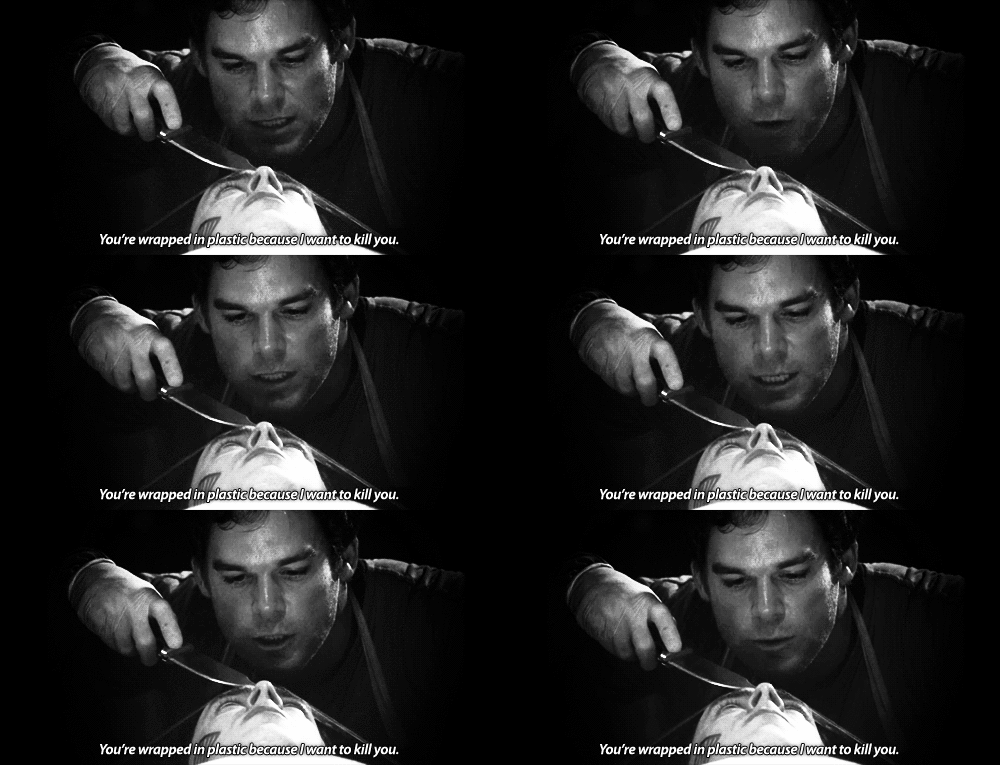
Dexter has an unique sense of justice and he believes that by placing his targets at death’s door, he might as well force them to see why they’ve been brought here. In the act known as the Kill Ritual, Dexter’s kill room becomes a shrine for the innocent lives whom his target has killed, lined with photos and momentoes, possibly even video footage, and lit candles.
At the center of the room, his target is held to the table by plastic wrap or duct tape, depending on the strength and size of the victim.They are almost always naked under the plastic wrap, having been stripped of their clothes to allow Dexter to easily cut through their flesh after they die.
Dexter usually allows the victim to wake up on their own, which takes anywhere from 3 to 6 hours after capture. Dexter makes sure that the murderer knows that they are being killed for their crimes. Most of his victims respond with denial of their crimes; however, almost all end up admitting to their crimes in the end.
During the Ritual, Dexter uses a scalpel cut his victim’s cheek. He takes a bit of their blood and creates a blood slide from the victim’s blood as a trophy.
6. Blood Trophy
Main article: Blood Slide Boxes
Just before the murder, Dexter collects a trophy from his victim so that he can relive the experience. Dexter’s trophy signature is to slice the victim’s cheek with a surgical scalpel (usually when he/she is still alive, but sometimes postmortem) underneath the victim’s right eye. He then collects a blood sample which he preserves between two laboratory slides.
Dexter neatly organizes the blood slides inside a wooden filing box, which he hides inside his air conditioner. Following the murder of Ray Speltzer, Dexter gave up on collecting trophies, and cremated the second box along with Speltzer’s corpse. When he killed Matt Caldwell, his first kill in almost ten years, Dexter initially improvised a blood slide from two broken pieces of glass before deciding not to take a trophy.
- In the Dexter Novels, Dexter keeps his trophies in a rosewood box in his bookcase.
7. Execute
While he has killed victims in many ways, Dexter will almost always end the ritual by stabbing the victim in the heart. In some circumstances, Dexter kills his victims in the way they had killed theirs, i.e. killing Santos Jimenez with a chainsaw. A method that Dexter used in Season One involved driving into a skull with a cranial power saw.
Dexter’s favored method to kill is a fatal stab wound to the heart or neck. For certain victims, he cuts through the neck with a hacksaw or reciprocating saw, or beheads with a cleaver. He often likes to ironically/poetically stage the deaths of killers using elements of their own style (e.g. stabbing Little Chino with his own machete, and dismembering Santos Jimenez with a chainsaw in the same manner in which his mother was killed.
- In the Dexter Novels, Dexter prefers a fillet knife, which involves an extended “exploration.”
8. Disposal
Dexter dismembers the bodies of his victims, and places the sections inside heavy duty black biodegradable garbage bags. He removes all of the plastic sheeting from the kill room, and verifies that he left no evidence behind. He loads the bags into the back of his vehicle and transfers them to his boat, where he adds rocks to weigh down the bags from near the dock. afterward sealing the bags with duct tape. He then takes the wrapped bags out on his boat and disposes of them by dumping them overboard into a oceanic trench.
In Season Two, this site is inadvertently discovered by scuba divers, so he changes tactics, taking the bodies farther offshore, where they will be intercepted by the Gulf Stream and carried to the North Atlantic. He no longer needs to add rocks. A few victims (including A.J. Yates and Clint McKay) are dumped into the Gulf Stream without being dismembered.
His disposal method can change, dependent on the victims or circumstances. At times, Dexter leaves bodies out to be discovered by the police, such as in the cases of Brian Moser and Ken Olson. Occasionally, an entirely different method is used, such as the cremation of Ray Speltzer.
In New Blood, Dexter’s disposal method changed. Due to no longer being near the Gulf Stream, Dexter initially disposed of his first victim in ten years, Matt Caldwell by burying him under his fire pit after dismembering him. When a police investigation into Matt’s disappearance began, he initially planned to dispose of the remains in the Iron Mine, before a bear scared him off and prevented this. He eventually burned the remains in the Iron Lake Sanitation Incinerator. Jasper Hodge was left for the police as Dexter was unable to dispose of him due to the police appearing before he could kill him. Elric Kane was initially left where he had been killed, but put under a tarp: Dexter later returned and dismembered him before disposing of him in the incinerator. Kurt Caldwell was dismembered and disposed of in the incinerator.
Sergeant Logan wasn’t disposed of and was left where he had been killed, due to Dexter not having time to dispose of him.